Pudhiyavan

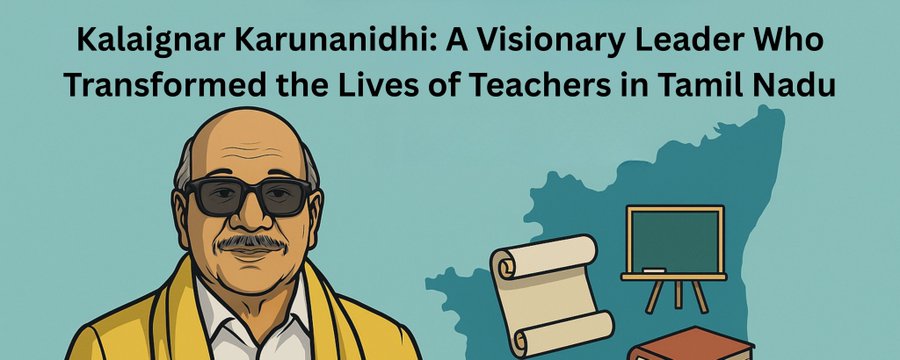
Kalaignar Karunanidhi: A Visionary Leader Who Transformed the Lives of Teachers in Tamil Nadu

Muthuvel Karunanidhi, affectionately known as Kalaignar, stands tall as one of Tamil Nadu’s most transformative leaders — a statesman who redefined education and elevated the stature of government school teachers. Across nearly two decades as Chief Minister, spanning five terms between 1969 and 2011, Karunanidhi pioneered reforms that reshaped the educational landscape, making Tamil Nadu a beacon of teacher empowerment and educational equity.

Kalaignar Karunanidhi: A Visionary Leader Who Transformed the Lives of Teachers in Tamil Nadu
Pudhiyavan 06 Jan 2026
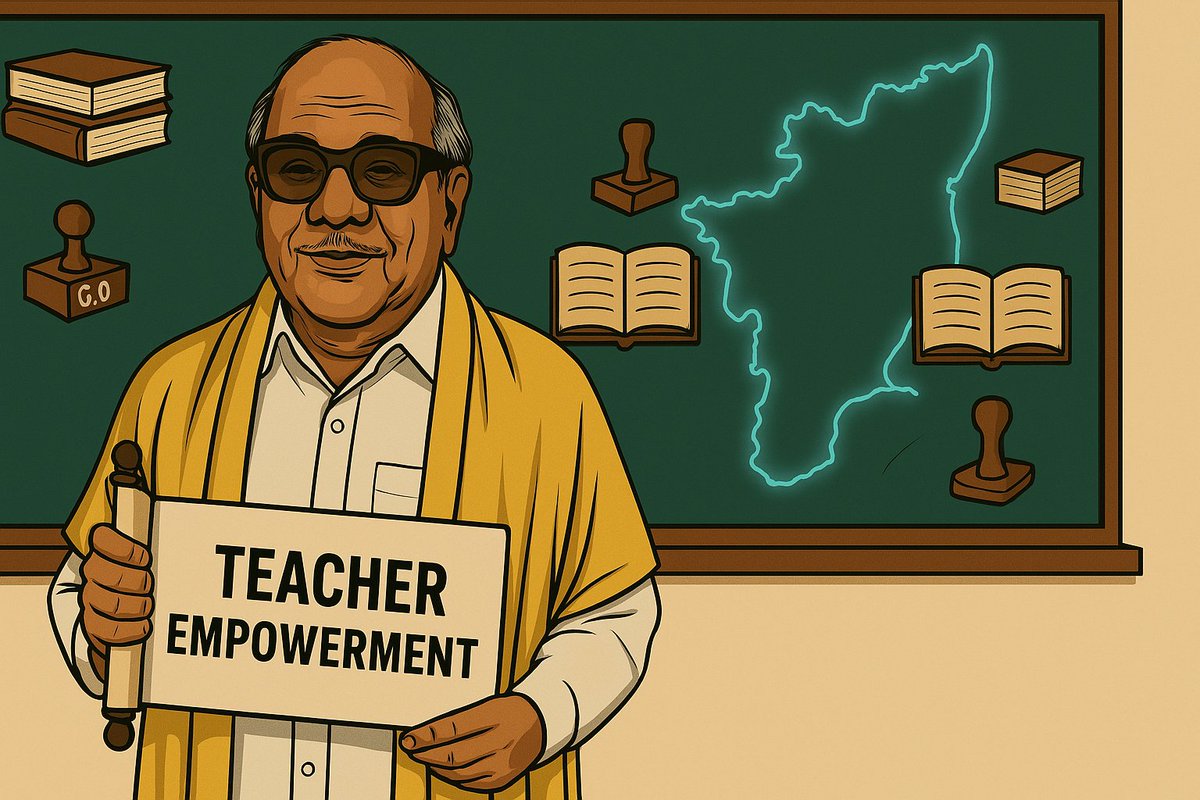
Through a series of landmark Government Orders (G.O.s), Kalaignar tackled head-on the pressing challenges of job security, professional dignity, and economic justice for teachers. His policies — firmly rooted in the Dravidian ideology of social justice — democratized access to education while systematically improving the conditions of those at the heart of the system: the teachers.
Widely hailed as the father of higher education in Tamil Nadu, Karunanidhi built upon the legacy of K. Kamaraj, but with a distinctive focus on higher education growth and comprehensive teacher welfare. His rationalist outlook ensured that educational reforms served both student progress and teacher empowerment, recognizing that true social upliftment begins in the classroom with well-supported educators.
Under his visionary leadership, the role of teachers evolved dramatically — from insecure, underpaid employees to respected nation-builders, entrusted with shaping generations. Today, this legacy stands as a cornerstone of what is celebrated as the in education: a model where teachers are valued not merely as government staff, but as pillars of social progress.
This article chronicles the pioneering initiatives of Kalaignar Karunanidhi that redefined the teaching profession in Tamil Nadu — reforms that continue to inspire educational policy across India.
 
Job Security through Regularization of Teachers and Government Staff
From as early as the 1970s, Kalaignar M. Karunanidhi recognised job insecurity as one of the gravest challenges confronting government school teachers. Determined to transform teaching into a secure and dignified profession, Karunanidhi’s government, during his third term as Chief Minister (1971–1976), undertook the mass regularisation of temporary teachers serving in government schools.
This bold and visionary move converted what was once a precarious and temporary occupation into a stable career path, significantly boosting teacher morale, commitment, and retention. For thousands of educators across Tamil Nadu, it marked the beginning of a new era of professional respect and security.
Karunanidhi’s commitment to job security did not end there. Decades later, during his fifth term, his government issued a series of landmark Government Orders to address the plight of teachers appointed on consolidated pay. Among these, .100 dated 27.06.2006 stands out for facilitating the large-scale regularisation of thousands of such teachers, restoring full service benefits and pay parity.
Through these decisive reforms, Kalaignar reinforced the foundational principle that teachers are not temporary staff, but essential pillars of the education system — deserving of secure employment and the full dignity of their profession.
Enhancing Professional Dignity through . 525 (29.11.1997)
During his fourth term as Chief Minister (1996–2001), Kalaignar M. Karunanidhi took a significant step towards protecting the professional dignity of teachers. His government issued the landmark . 525, Education Department, dated 29.11.1997, a measure that reflected his enduring belief that teachers are nation-builders, not clerks burdened with unrelated tasks.
This Government Order freed teachers from the obligation to perform non-academic duties such as:
  • Census operations
  • Election-related assignments
  • Other clerical or administrative tasks unconnected to education
By unshackling teachers from these responsibilities, Kalaignar ensured that they could focus fully on their primary role — educating and shaping future generations. This reform was a powerful affirmation of the respect his government accorded to the teaching profession.
Grievance redressal mechanisms: While . 525 specifically addressed non-academic duties, Karunanidhi’s broader governance during this period also saw the strengthening of institutional channels for teachers’ voices to be heard. He fostered open dialogue with teacher unions and ensured that teachers had direct avenues to escalate grievances beyond the local administration — a step that further reinforced their professional dignity.
Financial Empowerment of Teachers: Kalaignar’s Unwavering Commitment to Pay Parity, Economic Dignity, and Social Respect
One of Kalaignar Karunanidhi’s most impactful contributions came during his fifth and final term. Through . 234, Finance (Pay Cell) Department, dated 01.06.2009, his government implemented the recommendations of the 6th Central Pay Commission, thereby ensuring salary parity for Tamil Nadu’s teachers with Central Government scales.
This landmark decision fulfilled a long-standing promise to provide economic dignity to teachers and uplift their social status, making teaching a proud and viable profession in Tamil Nadu.
Uplifting Wages and Restoring Pay Parity
Alongside his efforts to secure employment, Kalaignar was deeply committed to ensuring fair wages and economic dignity for teachers. In .100 dated 27.06.2003, a junior grade system had been introduced for newly appointed teachers, placing them on consolidated pay and creating economic hardships for the teaching community.
Recognising the adverse impact of this policy, Kalaignar’s government issued a corrective measure through .99 dated 27.06.2006, withdrawing the junior grade scheme and restoring the regular time scale of pay system.
This major reform:
  • restored fair salary structures in line with service conditions made approximately 50,000 teachers eligible for salaries as per Pay Commission recommendations reaffirmed the government’s commitment to treating teachers as valued professionals deserving of financial stability, parity, and societal respect
  • Kalaignar’s government also pioneered the establishment of systematic pay enhancement mechanisms, constituting four pay commissions during his tenure to periodically review and improve salaries.
The Sixth Pay Commission implementation in 2009 resulted in:
  • Significant salary improvements, with revised scales effective from 01.01.2006 notionally and monetary benefits from 01.01.2007
  • Doubling of House Rent Allowance (HRA) and City Compensatory Allowance (CCA)
  • Extension of HRA and CCA benefits to noon meal workers for the first time
  • Enhancement of Death-cum-Retirement Gratuity ceiling from ₹3.5 lakh to ₹10 lakh
  • Increase of medical allowance from ₹50 to ₹100
Welfare through Kalaignar Kaappittu Thittam: Pioneering Health Security for Teachers and Their Families
As part of his visionary commitment to the welfare of government employees — especially teachers — Kalaignar M. Karunanidhi introduced the Kalaignar Kaappittu Thittam in 2009 during his fifth term as Chief Minister.
This pioneering health insurance scheme provided cashless medical coverage up to ₹1 lakh per year per family, enabling access to quality healthcare at empanelled private and government hospitals across the state. The scheme covered critical illnesses, major surgeries, and hospitalisation expenses, offering much-needed protection during medical emergencies.
For thousands of teachers and their families, the Kalaignar Kaappittu Thittam was more than a health policy — it was a vital social safety net. By shielding educators from financial hardship arising from health crises, it significantly enhanced their social security and well-being.
The scheme complemented Kalaignar’s broader reforms, reflecting his belief that the dignity of teachers must be upheld not only through fair pay and job security, but through comprehensive welfare and family care measures that support them at every stage of life.
Building Educational Capacity and Modernising Teaching: Kalaignar’s Visionary Reforms
From 1971 onwards, Kalaignar M. Karunanidhi’s governments spearheaded the expansion of educational infrastructure across Tamil Nadu, creating thousands of teaching posts and transforming the professional landscape for educators.
  • The number of government colleges more than doubled — from about 70 to 160 during his early terms — significantly boosting employment opportunities for teachers.
  • In 1990, Kalaignar advanced social justice by renaming Madras Law College as Dr. Ambedkar Government Law College, and in 1997, his government established the Tamil Nadu Dr. Ambedkar Law University, creating a new wave of posts in legal education.
  • That same year, he addressed job insecurity among specialised instructors by regularising around 800 part-time vocational group teachers with scale pay.
Recognising the need to equip classrooms for the digital era, Kalaignar pioneered IT integration in government schools:
  • In 1998, he became the first Chief Minister in Tamil Nadu to introduce computer education in government higher secondary schools, mandating structured training for teachers in Visual Basic, Java, FoxPro and other technologies.
  • Under the Samacheer Kalvi (Uniform Education) initiative (2011–12), computer education was extended to Classes VI to X, benefiting nearly 28 lakh students and requiring teachers to upskill in digital teaching methodologies.
Through these visionary reforms, Kalaignar not only expanded job opportunities but also empowered teachers to meet the demands of a modern, technology-driven education system.
Promoting Inclusivity and Shaping Teacher Representation (1989–2010)
M. Karunanidhi’s visionary policies did more than improve access to education — they fundamentally reshaped the teaching profession itself, opening its doors to underrepresented communities and ensuring that Tamil Nadu’s educator workforce reflected the state’s diverse social fabric.
EVR Nagammaiar Ninaivu Free Education Scheme (1989–90) Introduced during Karunanidhi’s tenure, this scheme provided free college education to girls from low-income families. The initiative, which raised the family income ceiling from ₹12,000 in 1989–90 to ₹24,000 in 1996, enabled thousands of young women — particularly from marginalised and backward communities — to pursue higher education. Many of these women later completed teacher training programmes (B.Ed., M.Ed.) and entered the teaching profession, helping dismantle historical barriers to entry.
69% Reservation Policy in Education and Employment (1990) Karunanidhi’s government introduced the pioneering 69% reservation policy, ensuring greater representation for Backward Classes, Most Backward Classes, Scheduled Castes, and Scheduled Tribes in both educational institutions and government jobs, including teaching posts. The policy dramatically expanded access to teacher education programmes and public sector teaching positions, bringing diversity and equity to a profession that had long been dominated by a few privileged sections of society. In 2010, the Supreme Court upheld the validity of Tamil Nadu’s 69% reservation framework, safeguarding the significant progress made in diversifying the teaching workforce.
The Outcome Karunanidhi’s inclusivity-focused reforms transformed teaching in Tamil Nadu from a traditionally elite occupation into a truly representative and democratic profession, empowering educators from every community to play their part in shaping the state’s future.
Strengthening Tamil Scholarship and Cultural Teaching Opportunities (2001)
In 2001, under Kalaignar Karunanidhi’s leadership, the Tamil Virtual University (now known as the Tamil Virtual Academy) was established, following his announcement at the Second Tamil Internet Conference (1999).
This pioneering initiative created new opportunities for Tamil language teachers, researchers, and scholars both in India and across the globe. The platform provided structured online learning in Tamil literature, culture, history, and technology-related Tamil studies, enabling teachers to engage with a global student community and preserve Tamil heritage through modern educational tools.
By blending technology with tradition, Kalaignar’s vision ensured that the teaching of Tamil language and culture flourished beyond geographical boundaries, creating dignified and innovative career avenues for educators.
A Living Legacy: From Kalaignar to Today

Kalaignar’s far-sighted reforms laid a strong and enduring foundation for Tamil Nadu’s education system. His initiatives in teacher welfare, job security, inclusivity, and educational excellence have not only transformed the teaching profession but also elevated the state’s standing in national education indices.
Today, Hon’ble Chief Minister Thiru M.K. Stalin carries forward this rich legacy. His government continues to build on Kalaignar’s visionary framework through sustained investments in teacher welfare, infrastructure modernisation, digital learning tools, and equitable curriculum reforms aimed at inclusivity and social justice.
From economic upliftment to emotional recognition, the Dravidian Model in education remains vibrant and resilient, thriving on the seeds of dignity, equality, and progress that Kalaignar planted decades ago — a living legacy that shapes the future of Tamil Nadu.
Conclusion
Kalaignar M. Karunanidhi’s transformative contributions to the teaching profession in Tamil Nadu remain a landmark in the annals of Indian educational history. Through a series of visionary government orders — notably .99, .100, and .22 — he institutionalized teacher regularisation, equitable pay, and job dignity, lifting the profession from the margins to the mainstream.
But beyond administrative reform, Kalaignar’s true legacy lies in his philosophy: that education is the cornerstone of social justice, and teachers are its most vital architects. From implementing pay commissions to pioneering computer literacy in classrooms, his holistic approach redefined the educator’s role in society — not merely as an instructor, but as a builder of future generations.
As Tamil Nadu continues to lead the nation in education indices, the onus now lies on today’s policymakers to uphold and evolve this legacy. In an era of rapid technological and social change, Kalaignar’s model offers more than a framework — it provides a compass rooted in equity, dignity, and progress. His vision affirms that the empowerment of teachers is not just an educational imperative, but a societal one — one that will continue to shape Tamil Nadu’s future for generations to come.
Recent Articles
No recent articles found.
About Pudhiyavan

Welcome to Pudhiyavan, your source for insightful articles and community updates.

Explore All Articles